
Confused about traffic, leads, and revenue? Learn the real difference, how they connect, and why most businesses waste budget focusing on the wrong metric. A practical guide for founders and marketing managers.
TLDR summary
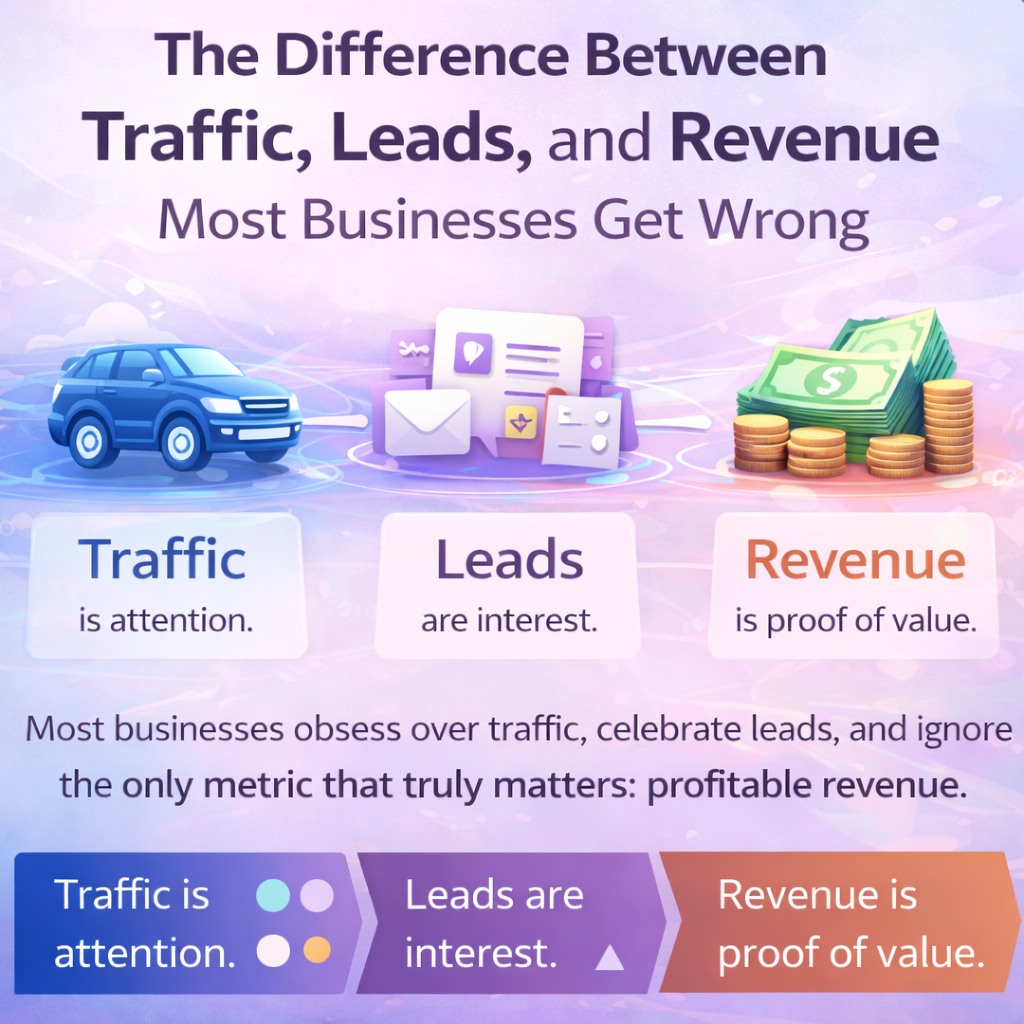
Traffic is attention.
Leads are interest.
Revenue is proof of value.
Most businesses obsess over traffic, celebrate leads, and ignore the only metric that truly matters: profitable revenue. The gap between these three stages is where most marketing budgets are wasted. This guide explains how they connect, where they break, and how to build a system that turns traffic into predictable revenue.
Traffic, Leads, and Revenue Are Not the Same Thing
One of the most expensive misconceptions in marketing is believing that traffic equals growth.
It does not.
Many founders proudly say, “We get 50,000 visitors per month.”
But when you ask how much revenue that traffic generates, the answer becomes unclear.
The real difference between traffic, leads, and revenue is simple in theory but critical in execution:
Traffic is visibility.
Leads are qualified interest.
Revenue is financial outcome.
If you misunderstand these distinctions, you will misallocate budget, hire the wrong agency, and optimize the wrong metrics.
Let us break this down clearly.
What Is Traffic
Traffic refers to the number of people who visit your website, landing page, or digital asset.
It can come from:
- Google search
- Paid ads on Meta or Google
- LinkedIn campaigns
- Email marketing
- Social media
- Referrals
- Direct visits
Traffic is the top of the funnel. It represents attention.
But attention alone has no financial value unless it moves forward.
Why Businesses Overvalue Traffic
Traffic is easy to measure.
Traffic looks impressive in reports.
Traffic inflates vanity metrics.
A campaign that drives 100,000 visits can still fail if:
- The wrong audience is targeted
- The offer is unclear
- The landing page does not convert
- There is no follow up system
For example:
A SaaS company spends $10,000 on ads and generates 20,000 visitors.
If none of them sign up, the traffic is irrelevant.
Traffic is potential energy.
Revenue is kinetic energy.
What Is a Lead
A lead is a visitor who takes a measurable action that signals interest.
Examples of leads:
- Filling out a contact form
- Booking a call
- Downloading a guide
- Starting a free trial
- Requesting a quote
A lead has moved from passive observer to active participant.
This is where real marketing begins.
The Lead Quality Problem
Not all leads are equal.
You can generate:
- Cheap leads
- Unqualified leads
- Curious leads
- Price shoppers
Or you can generate:
- High intent buyers
- Decision makers
- Budget approved prospects
The difference is in targeting, messaging, funnel design, and qualification filters.
Many agencies optimize for cost per lead.
Experienced operators optimize for revenue per lead.
That difference alone can transform a business.
What Is Revenue
Revenue is generated when a lead becomes a paying customer.
This is the only metric that sustains a business long term.
Revenue answers the real question:
Is your marketing profitable?
Revenue Is Not Just Sales Volume
Smart businesses evaluate:
- Customer acquisition cost
- Customer lifetime value
- Payback period
- Profit margins
- Retention rates
You can generate high revenue and still lose money if acquisition costs are too high.
This is where strategy matters.
How Traffic, Leads, and Revenue Actually Connect
Think of this as a system, not isolated metrics.
Traffic → Leads → Sales → Revenue → Retention → Lifetime Value
Break one link and the entire chain weakens.
Example 1: High Traffic, Low Revenue
A local dental clinic runs Meta ads and gets thousands of clicks.
But:
- The landing page is slow
- The booking form is long
- No reminder system exists
- No follow up for missed calls
Result:
Plenty of traffic.
Few appointments.
Minimal revenue impact.
Example 2: Moderate Traffic, High Revenue
Another clinic:
- Targets high intent keywords
- Uses a strong landing page
- Offers clear incentives
- Implements automated reminders
- Follows up within five minutes
Traffic volume is lower.
Revenue is significantly higher.
Optimization was done at the system level, not just the traffic level.
The Biggest Mistake Most Businesses Make
They hire agencies to generate traffic.
They should hire agencies to generate revenue.
If an agency reports impressions, clicks, and cost per click without connecting them to qualified leads and closed sales, you are not seeing the full picture.
At S2 Ads Agency, this is exactly why we focus on acquisition systems rather than isolated campaigns. Our Startup Plan begins at $1500 per month, and the objective is not traffic volume. The objective is profitable and measurable growth.
Traffic is easy to buy.
Profitability requires engineering.
How to Evaluate Your Own Marketing Funnel
Ask yourself these questions:
- Do we know our cost per qualified lead?
- Do we know our close rate?
- Do we know our cost per acquisition?
- Do we know our customer lifetime value?
- Are we optimizing for revenue, not just leads?
If you cannot answer these clearly, your growth is unpredictable.
And unpredictability is expensive.
Real World Scenario Breakdown
Let us use numbers.
Assume:
- 10,000 monthly visitors
- 5 percent conversion rate into leads
- 500 leads
- 20 percent close rate
- 100 customers
- $2000 average sale
Revenue equals $200,000.
Now change one variable:
Improve conversion rate from 5 percent to 7 percent.
New leads: 700
Same close rate: 20 percent
Customers: 140
Revenue: $280,000
You generated $80,000 more revenue without increasing traffic.
This is why understanding the difference between traffic, leads, and revenue changes strategy.
When Traffic Is Actually the Right Focus
There are cases where traffic is the constraint:
- Brand new websites
- SEO driven growth strategies
- Early stage awareness campaigns
- New product launches
But even then, traffic must be aligned with ideal customer profiles.
More traffic from the wrong audience is not growth.
It is distraction.
The Strategic Way to Think About Growth
Instead of asking:
How do we get more traffic?
Ask:
Where is our bottleneck?
- If traffic is low, invest in acquisition.
- If traffic is high but leads are low, fix conversion.
- If leads are high but revenue is low, fix qualification and sales.
Growth is rarely solved by doing more of the same.
It is solved by identifying the weakest link.
Why This Matters When Hiring a Digital Marketing Agency
When evaluating an agency, ask:
- How do you track revenue attribution?
- How do you define a qualified lead?
- What happens after a lead is generated?
- How do you connect ads to CRM data?
- How do you optimize based on sales outcomes?
If the conversation stays at clicks and impressions, that is a red flag.
A serious agency talks about:
- Funnel structure
- Conversion tracking
- CRM integration
- Sales alignment
- Lifetime value
- Profitability
Because traffic is input.
Revenue is output.
Final Takeaway
Traffic creates opportunity.
Leads create possibility.
Revenue creates sustainability.
Most businesses focus on the first stage and hope the rest happens automatically.
It does not.
Growth is engineered through systems that intentionally convert attention into income.
If you truly understand the difference between traffic, leads, and revenue, you stop chasing vanity metrics and start building predictable growth engines.
And that shift alone can change the trajectory of your company.
FAQs
What is the difference between traffic, leads, and revenue?
Traffic is the number of people visiting your website or landing page. Leads are visitors who share their contact information or take a qualifying action. Revenue is generated when those leads convert into paying customers.
Why is traffic alone not enough?
Traffic without conversion infrastructure leads to wasted ad spend. If visitors do not become leads or customers, high traffic only increases costs, not growth.
What is a healthy traffic to lead conversion rate?
It depends on industry and offer, but for most paid traffic campaigns 2 percent to 10 percent is a common range. High intent funnels can convert much higher.
How do you turn leads into revenue?
Through qualification, follow up systems, strong sales processes, nurturing sequences, and clear positioning. Marketing generates demand. Sales converts demand.
When should I hire a digital marketing agency?
If you are generating traffic but not converting, or if you want predictable growth and lack internal expertise to build and optimize a full acquisition system, it may be time to bring in specialists.
Leave a Reply