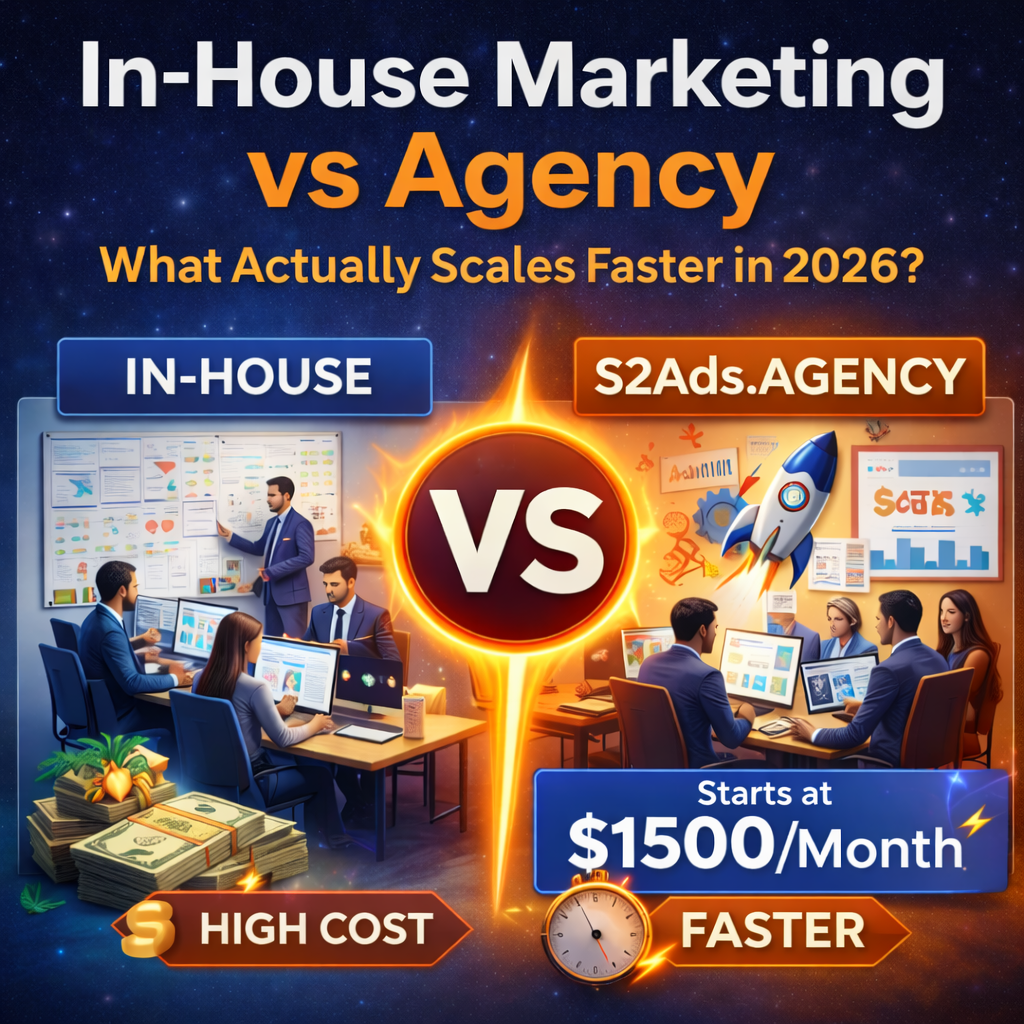

Should you hire in-house or use an agency? Compare real costs, speed to results, and scalability. Learn which option actually grows revenue faster for your business.
TLDR Summary
The Question: Your business is growing and marketing needs to scale. Do you hire an in-house team or partner with an agency? The decision affects speed, cost, quality, and your ability to grow revenue efficiently.
The Reality: Neither option is universally “better.” In-house teams excel at brand intimacy and long-term asset building. Agencies excel at speed, specialized expertise, and immediate execution without hiring overhead.
What Actually Happens:
- Agencies typically deliver results 3-6 months faster than building in-house teams
- In-house marketing costs $8,000-$25,000/month minimum (salary + tools + overhead)
- Agency packages start around $1,500-$5,000/month with full execution included
- In-house scales linearly (more work = more hires). Agencies scale more efficiently
- Best-performing companies often use hybrid models: strategic in-house lead + agency execution
The Core Insight: Speed to market matters more than most founders realize. The 6-month head start an agency provides often generates enough additional revenue to fund an eventual in-house team. Starting with agency partnership, then transitioning to hybrid as you scale, typically produces better outcomes than trying to build everything in-house from scratch.Bottom Line: If you need results in 30-90 days and don’t have $150,000+ to invest in building an in-house team, agency partnership scales faster. If you have capital, patience for 6-12 month buildout, and need daily hands-on collaboration, in-house can work. Most businesses under $5M revenue scale faster with agencies.
Your business just hit a growth inflection point. Revenue is climbing, customer acquisition is working, and you need marketing to scale proportionally. The current situation, a founder wearing the marketing hat plus maybe a VA handling social posts, isn’t going to cut it anymore.
You have two paths forward: build an in-house marketing team or partner with an agency. The decision feels monumental because it is. This choice affects your burn rate, speed to market, quality of execution, and ultimately how fast you can grow revenue over the next 12-24 months.
I’ve worked with over 150 companies navigating this exact decision, and I can tell you the conventional wisdom is mostly wrong. The framework most founders use to evaluate this choice overlooks the factors that actually determine success.
Let me show you what actually matters when comparing in-house marketing versus agency partnership, with specific focus on what scales faster and why.
The Real Cost Comparison: Beyond Salary Numbers
Most founders start this evaluation by comparing salary costs to agency fees. A marketing manager costs $70,000-$90,000 per year. An agency charges $2,000-$5,000 per month. The agency looks expensive at $24,000-$60,000 annually for what appears to be “just one person’s work.”
This comparison is fundamentally flawed because it ignores total cost of ownership and the actual value delivered.
The True Cost of In-House Marketing
That $70,000 marketing manager salary is just the beginning. Add 25-40% for benefits, payroll taxes, insurance, and administrative overhead. Your $70,000 hire actually costs $87,500-$98,000 in total compensation.
Now add the tools and software that person needs to be effective: marketing automation ($200-$1,000/month), analytics platforms ($100-$500/month), design tools ($50-$100/month), SEO and research tools ($100-$300/month), advertising accounts and management platforms ($100-$500/month). Budget $500-$2,000 monthly for tools, adding $6,000-$24,000 annually.
Don’t forget recruiting costs. Executive recruiters charge 20-30% of first-year salary. Even if you recruit yourself, expect to spend 40-60 hours on sourcing, interviewing, and evaluating candidates. At founder opportunity cost, this represents real expense.
Training and onboarding take 1-2 months before your new hire reaches productivity. During this period, you’re paying full salary while getting minimal output. Factor in 2-3 months of reduced productivity as they learn your business, industry, and customers.
Your true first-year cost for one marketing hire is $100,000-$125,000 minimum. And you get exactly one person with one skill set, one perspective, and limited bandwidth.
The True Cost of Agency Partnership
An agency package at $1,500-$5,000 monthly costs $18,000-$60,000 annually. This appears higher than a single salary until you consider what you actually receive.
You get immediate access to an entire team: strategist, copywriter, designer, media buyer, analyst. Each of these specialists would cost $60,000-$100,000 as individual in-house hires. The collective expertise in an agency package would require $300,000-$500,000 in annual salaries to replicate in-house.
All tools and software are included. The agency already subscribes to premium platforms, analytics tools, design software, and research resources. You pay nothing extra for tools that would cost $12,000-$30,000 annually if purchased separately.
No recruiting, onboarding, or training time. The agency starts executing within days, not months. This time-to-value advantage is worth tens of thousands in opportunity cost, especially if you’re in a competitive market where speed matters.
No overhead burden. When an agency team member leaves, you don’t care. When an in-house marketer quits, you start the expensive recruiting and onboarding cycle again, potentially losing 3-6 months of momentum.
The Real Comparison
Year one in-house: $100,000-$125,000 for one generalist with 5-8 month ramp time Year one agency: $18,000-$60,000 for specialist team with immediate execution
The agency provides 4-6x more expertise for half the cost with 5x faster time to results. This isn’t even close from a pure economic perspective.
The question isn’t whether agencies are more cost-effective. They obviously are for most companies. The real question is whether the in-house advantages (proximity, integration, long-term asset building) justify the 2-3x cost premium and slower time to results.
Speed to Market: The Metric That Actually Matters
In growth-stage companies, speed to market often matters more than perfect execution. A good campaign running this month generates more value than a perfect campaign launching in six months.
This is where agency partnership creates the most dramatic advantage over building in-house.
Agency Timeline: Week 1 to Results
Week 1: Onboarding, business analysis, competitive research, initial strategy development Week 2-3: Campaign development, creative production, landing page builds, technical setup Week 4: Campaign launch across initial channels Week 6-8: Optimization based on performance data Week 10-12: Measurable ROI and scaling decisions
Quality agencies deliver tangible business results within 60-90 days of engagement. You’re generating leads, acquiring customers, and building revenue before a single in-house candidate would even complete their first interview.
In-House Timeline: Month 1 to Results
Month 1-2: Write job descriptions, post positions, source candidates, conduct first-round interviews Month 2-3: Final interviews, offer negotiation, background checks, notice period at previous employer Month 3-4: Onboarding, training, learning the business and industry Month 4-5: Strategy development, tool setup, campaign planning Month 5-6: First campaign development and launch Month 7-9: Optimization and iteration toward meaningful results
Best case scenario, you see meaningful results 6-9 months after deciding to hire in-house. More realistically, it takes 8-12 months to build momentum with a new marketing hire.
The Revenue Impact of Speed
That 5-7 month head start the agency provides isn’t just about timing. It’s about cumulative revenue generation.
If an agency generates $15,000 in monthly profit contribution starting month two, by month eight (when your in-house hire is just launching their first campaign), the agency has generated $105,000 in profit contribution. This profit completely covers the agency fees and generates net positive ROI before your in-house approach even produces results.
Speed to market compounds. Early traction allows faster iteration, better data collection, and accelerated learning. Starting six months earlier means you’re six months ahead on optimization, which creates advantages that persist even after an in-house team eventually launches.
For most growth-stage companies, speed to revenue matters more than any other factor. Agencies win decisively on this dimension.
Skill Breadth vs Skill Depth: What Your Business Actually Needs
One of the biggest misconceptions about in-house versus agency is skill coverage. Founders often think hiring “a marketer” gives them comprehensive marketing capability. It doesn’t.
The Generalist Problem
A single marketing hire is necessarily a generalist. They might be stronger in content marketing or paid advertising or brand strategy, but they cannot possibly be expert-level across all disciplines modern marketing requires.
Modern marketing execution requires: paid search expertise, paid social media buying, organic social content creation, SEO technical knowledge, conversion rate optimization, email marketing, marketing automation, analytics and attribution, copywriting, design, and strategic planning.
No single person excels at all these functions. Your marketing hire will be competent at 2-3, proficient at 3-4, and weak or inexperienced in the remaining areas. You end up with uneven execution where some channels perform well while others underperform due to skill gaps.
The Agency Team Advantage
Quality agencies assign specialist teams to client accounts. You get a paid media buyer who only does paid media and has managed $10M+ in ad spend. You get a copywriter who writes copy daily across dozens of clients. You get a designer focused exclusively on conversion-optimized design.
This specialist depth matters enormously for execution quality. A generalist marketer might manage your Google Ads campaigns adequately. A specialist who manages 20 Google Ads accounts and has tested thousands of variations will deliver materially better results.
The breadth of an agency team means every channel gets specialist-level attention rather than generalist-level execution. Your paid ads, SEO, content, and email marketing all get expert execution simultaneously instead of sequentially as a single generalist rotates attention between channels.
When Generalists Actually Work Better
There are contexts where in-house generalists outperform agency specialists. Deep product knowledge, nuanced audience understanding, and brand voice consistency benefit from the intimacy only in-house team members develop.
If your marketing strategy relies heavily on thought leadership content, community building, or complex product education, in-house team members who deeply understand your product and customers often produce superior work compared to agencies creating content from external briefings.
For businesses where marketing is primarily about relationship cultivation rather than direct response campaigns, in-house proximity and authenticity advantages can outweigh agency specialist expertise.
The Hybrid Sweet Spot
The highest-performing marketing often comes from hybrid models: strategic in-house leadership combined with agency execution. An in-house marketing director who owns strategy and brand voice, paired with agency partners handling paid acquisition, content production, and technical execution, combines the advantages of both models.
This hybrid approach costs more than pure agency but less than a full in-house team, while delivering better results than either pure approach. A marketing director at $120,000 plus $36,000 in agency fees ($156,000 total) typically outperforms a $156,000 budget spent on either pure in-house or pure agency.
Scalability: Linear Growth vs Exponential Leverage
How each model scales as your business grows reveals important long-term strategic considerations beyond initial cost and speed comparisons.
In-House Scaling: Linear and Expensive
In-house teams scale linearly. More work requires more people. As marketing demands increase, you hire additional team members, each adding $100,000-$150,000 in annual cost.
Going from one marketer to a team of five costs $500,000-$750,000 annually in compensation, benefits, and overhead. Building a complete in-house marketing department with specialists across all functions requires 8-12 people at $800,000-$1,500,000 annual budget.
This linear scaling creates difficult decisions. Do you hire a dedicated paid media specialist or make your generalist marketer handle it despite limited expertise? Do you bring on a full-time designer or continue using inconsistent freelancers? Each hire is a major commitment with fixed costs that don’t flex with business performance.
Agency Scaling: Flexible and Efficient
Agencies scale more flexibly. Need to double ad spend and creative output? The agency assigns additional resources to your account at incremental cost far below hiring full-time employees.
Want to test a new channel? The agency has specialists ready to launch without you needing to hire, train, or manage new people. Need to pause certain activities during slow seasons? Agency contracts typically allow more flexibility than laying off employees.
This scalability advantage matters most during rapid growth or market uncertainty. When you’re scaling from $2M to $10M revenue, marketing demands might triple. Tripling an agency budget from $4,000 to $12,000 monthly is straightforward. Tripling your in-house team from two people to six is a major organizational expansion requiring recruiting, management infrastructure, and long-term commitment.
The Break-Even Point
There exists a scale point where in-house economics begin favoring internal teams. This typically happens around $5-10M in annual revenue when marketing budgets reach $500,000-$1,000,000+ annually.
At this scale, you can build a properly staffed in-house team (5-8 people) that costs less than equivalent agency services would at that budget level. The quality advantages of proximity and deep integration also increase at this scale because you have enough team members to cover specialist functions internally.
But most companies reading this article haven’t reached that scale yet. If you’re generating $500,000-$5,000,000 in annual revenue, agency partnership almost always scales faster and more capital-efficiently than building in-house.
Control and Communication: The Proximity Question
One of the most common concerns about agency partnership is loss of control and communication friction. Won’t an external team be less responsive and aligned than in-house employees?
The Control Perception
In-house teams sit in your office (or Slack channels). You can walk over and discuss strategy anytime. They attend every company meeting. They’re embedded in company culture. This proximity creates a feeling of control that many founders value highly.
This feeling is partially illusory. In-house teams aren’t necessarily more aligned or controllable than agencies. A disengaged employee can waste months producing low-value work while appearing busy. An in-house marketer pursuing the wrong strategy creates exactly the same business impact as an agency pursuing the wrong strategy.
True control comes from clear strategy, defined metrics, and rigorous accountability, not proximity. An agency with weekly performance reviews and transparent dashboards often provides more actual control than an in-house team operating without clear KPIs.
The Communication Reality
Quality agencies establish communication rhythms that provide clarity without excessive overhead. Weekly strategy calls, daily Slack communication, shared project management systems, and transparent reporting create alignment that rivals or exceeds typical in-house communication quality.
Poor agencies absolutely create communication problems. Slow response times, opaque processes, and lack of transparency are legitimate concerns. But these are agency selection problems, not inherent limitations of the agency model.
When evaluating agencies, assess their communication infrastructure explicitly. How do they handle day-to-day questions? What’s typical response time? How do they report results? What visibility do you have into work in progress?
Agencies with strong communication systems often provide better clarity than in-house teams because they’ve systematized communication rather than relying on ad-hoc updates.
When Proximity Actually Matters
There are scenarios where in-house proximity creates genuine advantages beyond perception. Companies with complex products requiring deep technical knowledge, businesses in highly regulated industries needing compliance oversight, and organizations where marketing and product development must integrate tightly all benefit from in-house team proximity.
If your marketers need to sit in on product development meetings, interview engineers about technical capabilities, or collaborate daily with sales on messaging, in-house structure facilitates this integration better than external partnerships.
Evaluate whether your specific business actually requires this level of integration or whether you’re overvaluing proximity based on comfort rather than strategic necessity.
Knowledge Retention and Long-Term Asset Building
What happens to your marketing capabilities when team members leave? This question reveals important differences between in-house and agency models for long-term asset development.
The In-House Knowledge Advantage
In-house teams build institutional knowledge about your business, customers, and market that accumulates over time. A marketer who’s been with your company for three years understands nuances that no external partner can match.
This knowledge manifests in better messaging, more relevant content, and strategic decisions informed by deep context. Long-tenured in-house marketers become invaluable strategic assets because they understand not just marketing execution but your entire business.
In-house teams also build enduring assets that remain with the company. Content libraries, customer research, brand guidelines, strategic frameworks, and documented processes all persist when individual team members leave because they’re company property.
The Agency Knowledge Vulnerability
When you terminate an agency relationship, you lose access to their accumulated knowledge about what works for your business. Campaign histories, testing insights, and optimization learnings often walk out the door with the agency.
Some agencies deliberately create dependency by maintaining opaque processes and keeping critical knowledge internal. When you leave, you start from zero with a new agency or in-house team.
This vulnerability is real but manageable through contract structure. Require monthly documentation of all tests, results, and strategic decisions. Maintain ownership of all advertising accounts, analytics properties, and creative assets. Ensure knowledge transfer is contractually required, not optional.
Well-structured agency relationships create knowledge repositories that persist beyond the partnership. Poor agency relationships create costly dependency that hampers your ability to change partners or bring capabilities in-house.
The Hybrid Knowledge Strategy
The best knowledge retention strategy combines in-house strategic ownership with agency execution partnership. An in-house marketing director owns the strategic knowledge and institutional memory while agency partners handle execution.
When agencies change, the in-house leader maintains continuity and can onboard replacement agencies efficiently. When in-house team members leave, the agency partnership provides stability during transition.
This hybrid structure maximizes knowledge retention while maintaining execution flexibility. It costs more than pure agency or junior in-house but provides significantly better long-term strategic continuity.
The Decision Framework: What Actually Determines the Right Choice
Stop trying to determine whether in-house or agency is universally “better.” Neither is. The right choice depends on your specific circumstances across several critical dimensions.
Revenue and Marketing Budget
Under $1M annual revenue: Agency partnership almost always optimal. You cannot afford effective in-house teams at this scale, and agency expertise accelerates growth toward the scale where in-house becomes viable.
$1M-$5M annual revenue: Agency partnership still optimal for most businesses. Marketing budgets of $100,000-$500,000 don’t support full in-house teams but can fund strong agency partnerships delivering complete marketing coverage.
$5M-$10M annual revenue: Hybrid models become optimal. In-house marketing leadership plus agency execution combines advantages of both models. Pure in-house becomes viable but rarely optimal.
$10M+ annual revenue: In-house teams become economically competitive with agencies at this scale. Most companies at this level maintain hybrid models with strong in-house teams plus specialized agency partners rather than going pure in-house.
Timeline and Urgency
Need results within 90 days: Agency is the only realistic option. You cannot hire, onboard, and ramp an in-house team quickly enough to meet aggressive timeline requirements.
Have 6-12 months to build: In-house becomes viable if you have other strategic reasons to prefer it. The timeline disadvantage is significant but not disqualifying if you have patience and capital.
Ongoing need with no deadline pressure: Either model works. Optimize for other factors like cost, control, and strategic fit rather than speed.
Complexity and Specialization
Running complex, multi-channel campaigns: Agencies typically provide better specialist coverage across channels. Building equivalent in-house expertise requires larger teams than most businesses can justify.
Focus on one or two channels deeply: In-house specialists can outperform agencies when you focus expertise rather than spreading across many channels. A dedicated in-house paid media expert running only Google and Facebook ads often beats an agency generalist managing ten different platforms.
Highly specialized or technical product: In-house teams better handle deep product knowledge requirements. Agency teams struggle with complex technical products requiring extensive expertise to market effectively.
Strategic Importance of Marketing
Marketing is core competitive advantage: Consider in-house earlier. If content, community, and brand are your primary business differentiators (like DTC brands or media companies), in-house teams aligned with product development create strategic value worth the cost premium.
Marketing is growth driver but not core product: Agency partnership typically optimal. If you’re a SaaS company, consulting firm, or service business where the product is separate from marketing, agency execution supports business growth without requiring internal capability building.
Real-World Scenarios: What Actually Works
Let me share specific examples from companies I’ve worked with to illustrate how these decisions play out in practice.
Case 1: SaaS Company, $2M ARR
This B2B SaaS company was generating $2M in annual recurring revenue with founder-led marketing. They debated hiring a marketing manager ($85,000) versus agency partnership ($3,500/month).
They chose agency partnership. Within 90 days, the agency launched paid search campaigns, rebuilt their website for conversion, implemented marketing automation, and established content production systems. Month four generated 47 qualified leads at $180 cost per lead. Month six scaled to 95 leads at $145 CPL.
By month eight, marketing-generated revenue exceeded $100,000 monthly, covering agency costs 3x over. The founder, freed from marketing execution, closed larger enterprise deals that grew revenue faster than if he’d remained focused on managing an in-house marketer.
At $5M ARR two years later, they hired an in-house marketing director to own strategy while maintaining the agency partnership for execution. This hybrid model continues outperforming either pure approach.
Case 2: E-commerce Brand, $800K Revenue
This DTC e-commerce company was generating $800,000 annual revenue primarily through Instagram organic reach. They needed to scale beyond founder posting to Instagram stories.
They attempted to hire in-house first. After three months of recruiting, they hired a “growth marketer” at $65,000. This person spent two months building a content calendar and setting up email automation but lacked paid advertising expertise to scale acquisition.
Five months in, they’d spent $32,500 in salary with minimal revenue growth. They switched to agency partnership at $2,500/month. The agency launched Facebook and Google ads within two weeks, implemented proper conversion tracking, and optimized their product pages for conversion.
Results appeared within 45 days. Paid advertising generated $45,000 in month two, $67,000 in month three, scaling to $120,000+ monthly by month six. They kept the in-house hire for customer community management and organic content while the agency handled paid acquisition.
Revenue grew from $800,000 to $2.1M within 18 months. The hybrid model combining in-house community building with agency performance marketing delivered results neither pure approach would have achieved.
Case 3: Professional Services Firm, $8M Revenue
This consulting firm at $8M annual revenue had operated without formal marketing for years, relying on referrals and founder networks. As founding partners approached retirement, they needed systematic client acquisition.
At their scale, they could afford either a substantial in-house team or premium agency partnership. They chose a hybrid approach: hired a Marketing Director ($140,000) plus agency partnership ($6,000/month) for execution.
The Marketing Director developed strategy, positioning, and messaging while managing the agency relationship. The agency executed website redesign, content production, paid advertising, and email nurture campaigns.
This combination worked excellently. The Director’s deep understanding of professional services and existing client relationships informed strategy that an agency alone couldn’t develop. The agency’s execution expertise and bandwidth delivered campaigns the Director couldn’t produce alone.
Revenue grew to $12M within two years, almost entirely from marketing-generated leads rather than referrals. At $12M, they expanded the in-house team to three people (Director plus two specialists) while maintaining the agency partnership for overflow capacity and specialized functions.
Making Your Decision: A Practical Assessment
You now understand the real tradeoffs between in-house marketing and agency partnership. Here’s how to make the right choice for your specific situation.
Step 1: Assess Your Current Position
What’s your annual revenue? If under $2M, agency partnership is almost certainly optimal. Between $2M-$5M, agency remains optimal for most businesses but hybrid becomes viable. Above $5M, evaluate hybrid or in-house based on other factors.
What’s your marketing budget? Under $100,000 annually, you can’t afford effective in-house. $100,000-$300,000 supports junior in-house or strong agency. $300,000-$500,000 enables hybrid models. Above $500,000, in-house becomes economically viable.
What’s your timeline to results? If you need impact within 90 days, agency is the only option. If you can wait 6-12 months, in-house becomes viable.
Step 2: Define Your Strategic Priorities
Is marketing speed or control more important? If speed to revenue is critical, agencies win. If control and long-term asset building matter more, favor in-house.
Do you need specialist depth or generalist integration? Specialist depth across multiple channels favors agencies. Deep integration with product and sales favors in-house.
Is marketing your competitive advantage? If yes, consider in-house earlier. If marketing supports your business but isn’t core differentiation, agencies work well.
Step 3: Calculate True Costs
For in-house: Salary plus 30% for benefits and overhead, plus $1,000-$2,000 monthly for tools, plus 2-3 months of onboarding opportunity cost, plus recruiting costs. Multiply by the number of people you’d need to cover required functions.
For agency: Monthly fee times 12, minus any setup fees. That’s your true annual cost, all-in with no hidden expenses.
Compare total cost against realistic output expectations. One $90,000 in-house marketer doesn’t provide the same output as a $36,000 agency team even though the in-house option costs more.
Step 4: Evaluate Available Options
If considering in-house: Can you actually recruit the quality of talent you need in your location at your budget? Honestly assess whether top marketing talent wants to work at your company at your compensation level. If not, your in-house plan won’t deliver expected results.
If considering agency: Research agencies working with similar-sized companies in your industry. Review case studies and references. Assess their communication systems and reporting transparency. Poor agency choice is worse than no agency.
If considering hybrid: Determine whether you can afford both an in-house strategic leader and agency execution support. Hybrid costs more upfront but often delivers best results.
Step 5: Plan the Transition Path
Don’t treat this as a permanent decision. Plan for evolution as your business scales.
If starting with agency: Define the revenue milestone where you’ll consider hiring your first in-house marketing person. Plan for that person to manage agency relationships initially rather than replacing the agency entirely.
If starting with in-house: Identify which specialized functions might eventually shift to agencies as you scale. Paid media, content production, and design often benefit from agency partnership even within larger in-house teams.
If starting with hybrid: Clarify division of responsibilities between in-house and agency from day one. Define which strategic decisions live in-house versus which execution decisions the agency owns.
Working With S2 Ads Agency: The Speed-to-Scale Advantage
At S2 Ads Agency, we’ve built our service model specifically for growth-stage companies facing this exact decision. Our packages start at $1,500/month for complete marketing setup and optimization, delivering specialist team access at a fraction of in-house costs.
We focus on speed to results because we know that’s what actually moves businesses forward. Within 30 days of engagement, we deliver:
Complete competitive analysis and positioning strategy Multi-channel campaign setup across paid search, paid social, and email Landing page optimization for conversion Analytics and tracking implementation Initial campaign launch and optimization
By day 60, you’re seeing measurable ROI. By day 90, we’re scaling what works and cutting what doesn’t. This speed advantage generates revenue that funds future growth, whether that’s continued agency partnership, hybrid models, or eventual in-house teams.
We also structure engagements to support rather than prevent eventual in-house building. All campaign data, creative assets, and strategic documentation belongs to you. We train your team members as you hire them. We’re building your marketing capabilities, not creating dependency.
For companies generating $500,000-$5,000,000 in annual revenue, our model typically delivers faster growth at lower cost than any alternative. We’re not trying to be your marketing team forever. We’re trying to accelerate your growth to the scale where you can build whatever team structure makes strategic sense.
The Bottom Line: What Actually Scales Faster
In-house marketing teams can scale businesses effectively, but they scale slowly and expensively. Building from scratch requires 6-12 months to reach productivity and costs $150,000-$300,000 annually for minimal coverage.
Agency partnerships scale faster, cost less initially, and provide broader expertise. Quality agencies deliver results within 60-90 days at $20,000-$60,000 annually, providing superior speed-to-value ratios.
For most businesses under $5M revenue, agency partnership is the fastest path to scale. The head start agencies provide generates enough additional revenue to fund eventual in-house teams if that’s your strategic preference.
The hybrid model combining in-house strategic leadership with agency execution delivers the best results for businesses at $3M-$10M revenue, though it costs more than either pure approach.
Stop debating which model is universally “better.” Start evaluating which model serves your specific revenue level, timeline requirements, and strategic priorities. For most companies reading this article, the honest answer is that agency partnership scales faster than building in-house from scratch.
The six-month head start is real. The cost savings are substantial. The specialist expertise advantage is significant. These factors compound over time, creating growth trajectories that pure in-house approaches struggle to match.
Choose the model that gets you to market fastest with the expertise you need at a cost your business can sustain. For most growth-stage companies, that model is agency partnership, at least initially.
Your business deserves marketing that drives revenue this quarter, not theoretically perfect marketing that might deliver results next year. Speed to scale matters more than most founders realize. Choose accordingly.
FAQs
Is it cheaper to hire in-house or use a marketing agency?
In-house appears cheaper on paper but carries hidden costs. A mid-level marketer costs $70,000-$90,000 salary plus 25-40% in benefits, taxes, and overhead, totaling $87,500-$126,000 annually. Add tools ($500-$2,000/month) and you’re at $93,500-$150,000+ per year for one person with limited skill breadth. Agencies typically cost $18,000-$60,000 annually for comparable or superior results with entire team access and no overhead costs. Agencies are usually more cost-effective until you reach $5-10M revenue where in-house economics improve.
How long does it take to see results from an agency vs building in-house?
Agencies typically deliver measurable results within 30-90 days because they start executing immediately with existing expertise and systems. Building in-house requires 2-3 months for hiring, 1-2 months for onboarding, and 2-3 months for the new hire to reach full productivity, meaning 5-8 months before meaningful results. This 3-6 month speed advantage often generates enough additional revenue to justify agency costs entirely.
Can an agency really understand my business like an in-house team would?
Quality agencies develop deep business understanding through structured onboarding, regular communication, and performance accountability. While in-house teams have daily proximity advantage, agencies compensate through experience across multiple businesses in your industry, bringing best practices and insights your in-house team wouldn’t discover independently. The understanding gap is smaller than most founders assume, and often reversed in specialized areas where agencies have superior expertise.
What size company should build an in-house marketing team?
Companies generating $5-10M+ in annual revenue can typically justify in-house teams economically. Below this threshold, agency partnerships usually deliver better ROI. The exception is if marketing is your core competitive advantage (like DTC brands where content and community are the product), in which case earlier in-house investment makes strategic sense. For most B2B companies and service businesses, agency partnership until $5M+ revenue optimizes growth speed and capital efficiency.
Should I use an agency or hire a marketing director?
This is often a false choice. A marketing director provides strategy and leadership but still needs execution support. The hybrid model works best: hire a strategic marketing lead in-house ($100,000-$150,000) who manages agency partners handling execution. This combines strategic ownership with execution velocity. If you can only afford one or the other, agencies provide more immediate value because they deliver both strategy and execution, whereas a director without execution resources produces plans but not results.
How do I transition from agency to in-house as we grow?
The best transition is gradual, not abrupt. Keep agency partnerships while hiring your first in-house marketer. Have them work together for 3-6 months for knowledge transfer. As your team grows, shift agencies from full-service to specialized roles (just paid ads, just content, etc.). Many successful companies maintain agency partnerships indefinitely for specialized functions while building in-house teams for brand strategy and coordination. Complete transitions often backfire because you lose institutional knowledge and momentum during the switch.
Leave a Reply