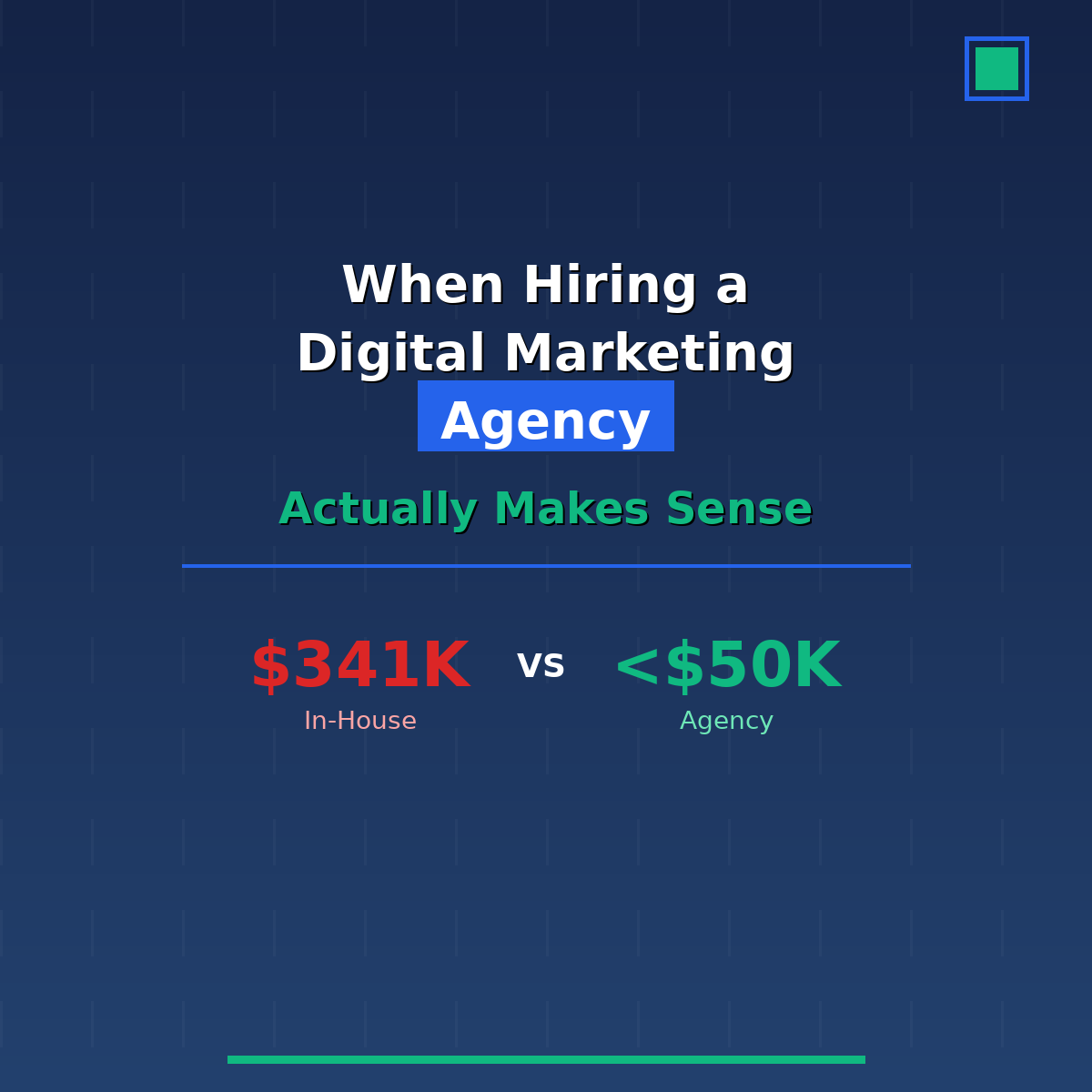

Hiring a digital marketing agency makes sense when you need specialized expertise fast, want to scale without the overhead of building a team, or operate with revenue under $5M annually. The true cost of a three-person in-house marketing team exceeds $340,000 yearly when you factor in salaries, benefits, tools, and overhead. Meanwhile, a capable agency retainer runs $96,000-$150,000 annually and delivers a full specialist team from day one. Agencies excel for businesses in growth mode, those launching new products, companies without existing marketing infrastructure, and brands that need multiple channel expertise. The decision comes down to three factors: your growth stage, the consistency of your marketing needs, and whether you value speed and flexibility over complete control.
The question of whether to hire a digital marketing agency keeps more business leaders awake at night than it should. Not because the answer is complicated, but because the stakes feel impossibly high. Make the wrong call and you’re either burning cash on overhead or leaving growth on the table.
Let me cut through the noise. After working with hundreds of businesses at different stages, I’ve seen this decision play out enough times to know exactly when an agency makes sense and when it doesn’t.
The real issue isn’t whether agencies are “better” than in-house teams. It’s about matching your marketing structure to your actual business reality right now, not the business you hope to be in three years.
Most founders and executives approach this backward. They start with preferences (“I want control” or “I don’t want to manage people”) instead of data. They compare a single salary line to an agency retainer and think they’re doing real cost analysis. They’re not.
Here’s what you actually need to know.
The Real Math Behind Marketing Team Costs
When someone tells you they’re building an in-house marketing team to “save money,” they’re either lying to you or lying to themselves. The salary is never the full story.
A marketing manager earning $90,000 doesn’t cost you $90,000. Not even close.
Add 20-30% for benefits and payroll taxes. That’s another $18,000-$27,000. Throw in recruitment fees if you’re using an agency or recruiter to find talent, which runs 15-25% of first-year salary. For that $90,000 hire, you just spent $13,500-$22,500 to find them.
Now equip them to do their job. Marketing automation platform, CRM, analytics tools, email service provider, SEO tools, social media management software, design tools, project management systems. You’re looking at $2,000-$3,000 monthly just for a basic stack. That’s $24,000-$36,000 annually.
Training and professional development to keep their skills current adds another $1,000-$3,000 per year. Office space, equipment, IT support, and general overhead pile on more.
Let’s run a realistic scenario. You want a lean three-person team: a marketing manager, a paid media specialist, and a content creator. Here are the numbers:

In-House Team Annual Cost:
- Three salaries ($90K + $70K + $60K): $220,000
- Benefits and payroll taxes (25%): $55,000
- Recruitment costs: $18,000
- Marketing tools and software: $24,000
- Training and development: $9,000
- Equipment and overhead: $15,000
- Total: $341,000
Agency Partnership Annual Cost:
- Monthly retainer ($8,000 x 12): $96,000
- Full specialist team: Included
- All marketing tools: Included
- Strategic consulting: Included
- Scalable capacity: Included
- Total: $96,000
The agency delivers the same functional capacity for less than a third of the cost. And that’s before we talk about the operational burden you’re not carrying.
When someone on your in-house team quits, which they will, you’re eating the cost of that empty seat while you recruit, hire, and onboard their replacement. Industry data shows the cost of employee attrition runs 50-200% of annual salary depending on role and seniority. For a $70,000 media buyer, losing them costs you $35,000-$140,000 in productivity loss, recruitment, and ramp-up time.
Agencies don’t have that problem. Someone leaves their team? That’s their problem to solve, not yours. Your campaigns keep running.
This is why agencies often deliver better ROI for small and mid-sized businesses. Not because they’re smarter or work harder, but because the cost structure makes mathematical sense.
When Agency Hiring Actually Makes Strategic Sense
The decision to hire an agency isn’t about cost alone. It’s about timing, capacity, and strategic fit. After working with businesses from seed-stage startups to eight-figure enterprises, certain patterns repeat consistently.
You’re in Early-Stage Growth (Under $5M Revenue)
If your business generates less than $5 million annually, building a comprehensive in-house marketing team is almost always the wrong move financially. You don’t have the budget to attract senior talent across multiple disciplines, and generalists will leave you with mediocre execution everywhere.
Agencies give you immediate access to specialists. Need someone who actually knows how to structure Google Ads campaigns? Done. Someone who understands technical SEO? On it. A designer who can produce scroll-stopping creative? Already on the team.
You’re not training anyone. You’re not managing performance reviews or dealing with interpersonal conflicts. You’re buying results.
For businesses at this stage, every dollar counts. Spending $341,000 on a small team when a $96,000 agency retainer delivers comparable or better output is poor capital allocation. That $245,000 difference funds product development, inventory, or hiring in areas where in-house makes more sense.
You Need Multiple Marketing Channels Running Simultaneously
Modern marketing requires execution across paid search, paid social, organic search, email, content, and often more. Building internal expertise across all these channels means hiring at least five people, each with specialized knowledge.
That’s $350,000-$900,000 in annual payroll costs alone. Most businesses under $20 million can’t justify that investment, especially when half those channels might not even work for their business model.
Agencies bundle cross-channel expertise. One retainer gets you paid media buyers, SEO specialists, content creators, designers, and strategists who work together daily. They’ve run these plays dozens of times for other clients. They know what works and what doesn’t.
When you’re testing channels to find what drives growth, agencies let you experiment without committing to full-time headcount for channels that might fail.
Speed Matters More Than Brand Immersion
If you’re launching a new product, entering a new market, or responding to a competitor threat, waiting 6-12 months to build an internal team will kill your momentum. Recruitment alone takes 2-4 months per position. Onboarding and ramp-up adds another 3-6 months before new hires reach full productivity.

Agencies start executing in 1-2 weeks. They bring established processes, proven playbooks, and teams that don’t need hand-holding. When market timing is critical, that speed advantage is worth far more than the cost difference.
I’ve watched companies lose entire market opportunities because they insisted on hiring internally when an agency could have had campaigns live in two weeks. By the time their new hire was up to speed, the window had closed.
Your Marketing Needs Are Project-Based or Seasonal
Businesses with inconsistent marketing needs suffer with in-house teams. You hire for peak capacity, then carry excess payroll during slow periods. Or you hire for average capacity and can’t scale when opportunities arise.
Agencies solve this elegantly. Need to triple ad spend for a product launch? They scale up. Pulling back during your slow season? You adjust the retainer or pause specific services.
Try doing that with employees. Hiring is slow and expensive. Layoffs destroy morale and leave you rebuilding when you need to scale again. Fixed headcount creates a terrible trade-off: constant over-staffing or constant under-capacity.
You Don’t Have Marketing Leadership In-House
If you’re a founder or executive without marketing expertise, hiring individual contributors before hiring a marketing leader is backwards. Junior and mid-level marketers need direction, strategic oversight, and mentorship to be effective.
Bringing on a VP of Marketing first makes sense, but now you’re committing to $150,000-$250,000 in compensation for one person before you have a team for them to lead. If that hire doesn’t work out, and 50% of executive hires don’t in the first 18 months, you’ve burned a year and a quarter-million dollars.
Agencies come with leadership built in. Their account strategists and directors function as outsourced marketing leadership. They set strategy, manage execution, and report results. You get the strategic oversight without betting your entire marketing budget on a single executive hire.
When In-House Actually Makes More Sense
I’m not here to sell you on agencies as a universal solution. They’re not. Certain business situations genuinely favor building internally.
Understanding when to keep marketing in-house is just as important as knowing when to outsource.
You Have Consistent, High-Volume Work That Justifies Dedicated Roles
If you’re spending $100,000+ monthly on paid advertising, a full-time media buyer can optimize performance in ways that justify their cost. If you need 50+ pieces of content monthly, an internal content team makes economic sense.
The key word is consistent. When your marketing needs are predictable and substantial, fixed costs become efficient. You’re maximizing utilization of dedicated resources.
But most businesses don’t operate at that scale. If you’re spending $15,000 monthly on ads, a full-time media buyer is over-resourced. They’ll either work on low-value tasks to fill their time or they’ll get bored and leave.
Your Industry Has Complex Compliance Requirements
Highly regulated industries like healthcare, finance, and legal services often require deep, sustained knowledge of compliance frameworks. Marketing in these spaces isn’t just about conversion rates. It’s about staying within regulatory boundaries that shift constantly.
In-house teams can build institutional knowledge around what’s permissible, what requires legal review, and how to navigate gray areas. They develop relationships with compliance officers and legal counsel that make execution smoother.
Some agencies specialize in regulated industries and navigate these complexities well. But if compliance is truly central to your marketing execution, internal resources who live and breathe your specific regulatory environment often execute with fewer roadblocks.
Brand Control Is Mission-Critical to Your Business Model
Certain brands live and die on consistency of voice, visual identity, and messaging nuance. Luxury brands, highly differentiated consumer brands, and companies where brand equity drives premium pricing often need the level of control that only in-house teams provide.
When every piece of content needs to thread a specific needle, when your brand guidelines run 100 pages, when executional precision matters more than speed or cost efficiency, internal teams have advantages. They internalize your brand at a level that’s hard for external partners to replicate, even good ones.
This isn’t universal. Most businesses overestimate how much brand immersion matters to performance. But for the subset where it genuinely drives business outcomes, in-house makes sense.
You’re Large Enough to Build Depth Across Functions
Once your business exceeds $20-30 million in revenue and your marketing budget allows for genuine depth, in-house teams become viable. You can afford to hire specialists in each channel, build management layers, and create internal infrastructure.
At this scale, agencies often transition to specialized roles. You keep strategy, brand, and operations in-house while agencies handle specific executional needs like creative production, media buying at scale, or technical implementation.

The hybrid model dominates at this level. According to recent industry surveys, 73% of companies use a combination of in-house and agency resources. They’re not choosing sides. They’re optimizing for different types of work.
The Hybrid Model Most Smart Companies Actually Use
The binary framing of this decision is a trap. In-house versus agency isn’t actually how most successful companies operate once they reach certain scale. They use both, strategically allocated to play to each model’s strengths.
I see this pattern repeatedly with well-run marketing organizations. They build internal capacity where control, consistency, and institutional knowledge matter most. They bring in agencies where speed, specialization, and flexibility deliver better outcomes.
Typical hybrid structure for a mid-sized business:
Keep In-House:
- Marketing leadership and strategy
- Brand management and messaging
- Core content and editorial
- Marketing operations and tech stack management
- Customer data and analytics infrastructure
Outsource to Agency:
- Paid media buying and optimization
- Conversion rate optimization and landing page testing
- Technical SEO implementation
- Creative production at scale
- Specialized channel expertise
This structure captures the best of both worlds. Your internal team owns strategy and brand while agencies handle executional scale and specialized capabilities your team can’t or shouldn’t build.
The cost profile makes sense too. You’re maintaining 2-3 strategic internal roles instead of 8-10 to cover every function. That’s $250,000-$400,000 internally plus $60,000-$120,000 in agency support, totaling $310,000-$520,000. That’s less than trying to build everything in-house while delivering better results through specialization.
This approach also solves the scaling problem. When you need to ramp up paid spending for a launch, you adjust agency scope. When budgets tighten, you can reduce agency work without layoffs. Your core team remains stable while execution capacity flexes with business needs.
The companies who struggle are the ones who treat this as permanent. Your optimal structure shifts as your business evolves. A startup that begins 100% agency should gradually bring strategic roles in-house as revenue grows. A mid-sized company might shift from hybrid back to mostly agency if they enter new markets requiring different expertise.
Making the Decision: A Framework That Actually Works
Stop starting with your preference or gut feeling. Those lead to expensive mistakes. Here’s the framework I use when advising businesses on this decision.

Start with three diagnostic questions:
Question 1: What stage of business are we in?
Calculate your last twelve months of revenue. Where you fall determines your default position:
- Under $1M: Strong agency default
- $1M-$5M: Agency default with strategic exceptions
- $5M-$20M: Hybrid model territory
- Above $20M: Evaluate based on other factors
This isn’t arbitrary. These ranges reflect when you have budget to support different structures. A $2M business spending 10% of revenue on marketing has $200,000 total. That’s enough for an agency retainer plus tools. It’s not enough for multiple full-time marketers plus tools.
Question 2: How consistent and predictable is our marketing work?
Map your marketing needs across a year. If they’re steady and repetitive, in-house efficiency improves. If they’re spiky, project-based, or experimental, agency flexibility wins.
Ask yourself: Could we keep a full-time person busy 40 hours weekly, 50 weeks per year, with valuable work in their specialty? If the answer is no for any role, you’re better off with an agency for that function.
Most businesses discover their needs are less consistent than they thought. Your paid media needs triple during holiday season. Content production spikes around launches but plateaus otherwise. You need design resources in bursts, not steady streams.
This variability makes the fixed cost of employees inefficient. You’re either over-resourced most of the time or under-resourced when it matters.
Question 3: Do we have existing marketing leadership or expertise?
Be brutally honest. Does your team have anyone who can provide strategic direction, evaluate performance, and course-correct when tactics fail?
If yes, you can hire executors and build in-house capacity. If no, you need to buy strategy and leadership along with execution. That makes agencies attractive because you’re getting the full stack.
Many businesses hire junior marketers without leadership to guide them, then wonder why results disappoint. Those marketers aren’t bad. They’re under-resourced and under-directed. Either hire senior leadership first, or partner with an agency that provides it.
Red Flags That You’re Making the Wrong Call
Certain warning signs indicate you’re about to make an expensive mistake on this decision. Watch for these patterns.
Red Flag 1: You’re Hiring In-House Primarily for “Control”
If your main reason for building internally is wanting control over every decision and execution detail, you’re probably not ready to delegate effectively to anyone, internal or external.
This mindset creates micromanagement problems that slow everything down. It also suggests you haven’t defined clear success metrics. When you know what outcomes you need and how to measure them, you care less about controlling the process.
Control for control’s sake is expensive. It costs you speed, specialist expertise, and flexibility. Make sure you’re not confusing control with effectiveness.
Red Flag 2: You’re Choosing an Agency Because You Don’t Want to Manage People
Agencies aren’t a way to avoid management. You still need to provide direction, review work, and ensure alignment. If you think hiring an agency means you can ignore marketing entirely, you’ll get mediocre results and blame the agency.
Good client-agency relationships require active involvement. You’re buying specialized execution, not abdication of responsibility. If you’re not willing to invest time in briefings, feedback, and strategic discussion, neither in-house nor agency will work well.
Red Flag 3: You’re Comparing Only Base Salary to Agency Cost
If your cost analysis stops at comparing a $90,000 salary to a $120,000 agency retainer, you’re missing 60% of the real costs. Scroll back up and look at the full cost breakdown again.
This surface-level analysis leads businesses to hire internally thinking they’re saving money, only to discover the true cost exceeds their entire marketing budget once they factor in everything else.
Do the complete math or you’re making decisions on incomplete information.
Red Flag 4: You’re Expecting Instant Results From a New Hire
If you hire someone and expect them to deliver results in month one, you’ll be disappointed. New employees need 3-6 months to become fully productive. They need to learn your business, your customers, your products, and your internal processes.
This ramp time is real cost. You’re paying full salary for partial output for months. If you can’t afford that time and cost, agencies make more sense because they deliver from week one.
Red Flag 5: You Haven’t Talked to Either Option Yet
Making this decision in theory, without talking to actual agencies or interviewing potential hires, leaves you operating on assumptions. Your assumptions are probably wrong.
Talk to three agencies. Understand their capabilities, approach, and pricing. Interview candidates for the roles you’d hire. See what talent is actually available in your market at your budget.
Real market intelligence beats theoretical analysis. Always.
What Happens When You Make the Wrong Choice
Let me walk you through the actual cost of getting this wrong, because it’s higher than most realize.
Scenario 1: You Build In-House When You Should Have Hired an Agency
Month one, you post job descriptions and start recruiting. Month three, you’re still interviewing because good candidates are scarce. Month five, you make an offer that gets accepted. Month six, your new hire starts.
Months six through eight are onboarding. They’re learning your business, your customers, your brand. They’re figuring out your internal processes and building relationships across the company. They’re well-intentioned but not productive yet.
Month nine, they start executing with some momentum. Month eleven, they tell you they’re overwhelmed because they’re one person trying to execute an entire marketing strategy. You need to hire more people, which restarts this cycle.
You’re now thirteen months in, you’ve spent $90,000+ in salary and overhead, and you still don’t have a functioning marketing program. Meanwhile, competitors who hired agencies lapped you three times.
This is the hidden cost of choosing wrong. It’s not just the money. It’s the lost time, the lost opportunities, and the revenue you didn’t capture because marketing wasn’t working.
Scenario 2: You Hire an Agency When You Should Have Built In-House
Less common, but it happens. You’re a $30M business with consistent, high-volume needs. You hire an agency because it feels easier than recruiting.
Three months in, you’re frustrated. The agency doesn’t understand your business like an internal person would. They’re working on other clients. Response times are slower than you want. You’re spending $15,000 monthly but feeling like you’re not getting enough attention.
You were never the right client for an agency. Your needs required dedicated resources who could build deep institutional knowledge. The agency model optimizes for flexibility and breadth, but you needed depth and immersion.
Now you’re out $45,000 with mediocre results, and you still need to start the hiring process you should have begun initially.
Both scenarios waste six-figure sums and half a year or more. Both are avoidable if you match your structure to your actual situation.
Questions to Ask Before Signing Any Agreement
Whether you’re hiring an agency or building internal capacity, certain questions need answers before you commit. Skip these and you’ll regret it within three months.
For Agency Partnerships:
What’s included in your retainer versus what costs extra? Many agencies advertise one price then nickel-and-dime you on implementation, design work, or additional channels. Get a clear breakdown of what the base retainer covers and what triggers additional fees.
Who will actually work on our account day-to-day? You’re sold by senior people who won’t touch your account after the contract signs. Understand who executes, how much experience they have, and how much access you get to senior strategists.
How do you handle underperformance? What happens if campaigns aren’t hitting targets after 90 days? Do they adjust approach, bring in additional resources, or just blame market conditions? Clear accountability frameworks matter.
What’s your communication cadence and reporting structure? Weekly check-ins? Monthly deep dives? Quarterly business reviews? Define expectations upfront because communication breakdowns kill client-agency relationships faster than poor performance.
For In-House Hires:
Beyond the role we’re hiring for, what other marketing functions do we need? One hire is rarely enough. Map out the complete picture so you’re not surprised when your new marketing manager tells you they need a designer, a copywriter, and a media buyer to execute anything meaningful.
Do we have leadership in place to direct this person? If you’re hiring individual contributors without someone senior to guide them, you’re setting them up to fail. Consider whether you need to hire leadership first.
What tools and technology will they need to be effective? Budget for the full marketing stack they require. Don’t hire someone then tell them they can’t have the tools that make their work possible.
How will we measure success in the first 90 days versus the first year? New hires need time to ramp. Define realistic expectations for early performance versus long-term results so you’re not making premature judgments.
These questions surface misalignments before they cost you serious money and time.
The Bottom Line on Agency Hiring
If you take nothing else from this, remember this: the decision to hire a digital marketing agency versus building in-house isn’t about which model is “better.” It’s about matching your marketing structure to your business stage, budget, and strategic needs right now.
Agencies make the most sense when you’re under $5M in revenue, need multiple channels managed simultaneously, require fast execution, or have variable marketing needs that make fixed headcount inefficient. The cost advantage is substantial and the speed advantage is even more valuable.
In-house makes sense when you have consistent high-volume work, operate in heavily regulated environments where compliance expertise matters, or you’ve scaled to where you can afford genuine specialist depth across functions.
Most mature businesses end up in a hybrid model, keeping strategy and brand in-house while outsourcing specialized execution to agencies. This isn’t compromise. It’s optimization.
The companies that win are the ones who match their structure to their reality and remain willing to change as their business evolves. The ones who lose are the ones who make this decision based on ego, fear, or incomplete cost analysis.
Run the real numbers. Understand your actual needs. Be honest about your capacity to manage different models. Then choose accordingly.
And if you’re still not sure? Start with an agency for 6-12 months. It’s easier to transition from agency to in-house once you’ve proven the marketing works than to build internal capacity only to discover your entire approach was wrong.
At least with an agency, you can fail fast, learn quickly, and adjust course without massive sunk costs in hiring and infrastructure. That flexibility alone makes it the right starting point for most businesses reading this article.
Your competitors already figured this out. Now you have too.
Leave a Reply